Skip to content
You catch it in the bathroom mirror: a thin red line branching across your cheek that was not there last year. Or a soft blue web on your calf, visible only in certain light. Nothing hurts. It simply does not fade.
Two approaches dominate the conversation about fine, visible vessels: light-based therapy and injections. Vascular laser treatment vs sclerotherapy is rarely a question of which one is stronger. The vein itself decides, based on its size, its depth, and where it sits on your body.
What is the difference between laser and injections for treating visible veins?
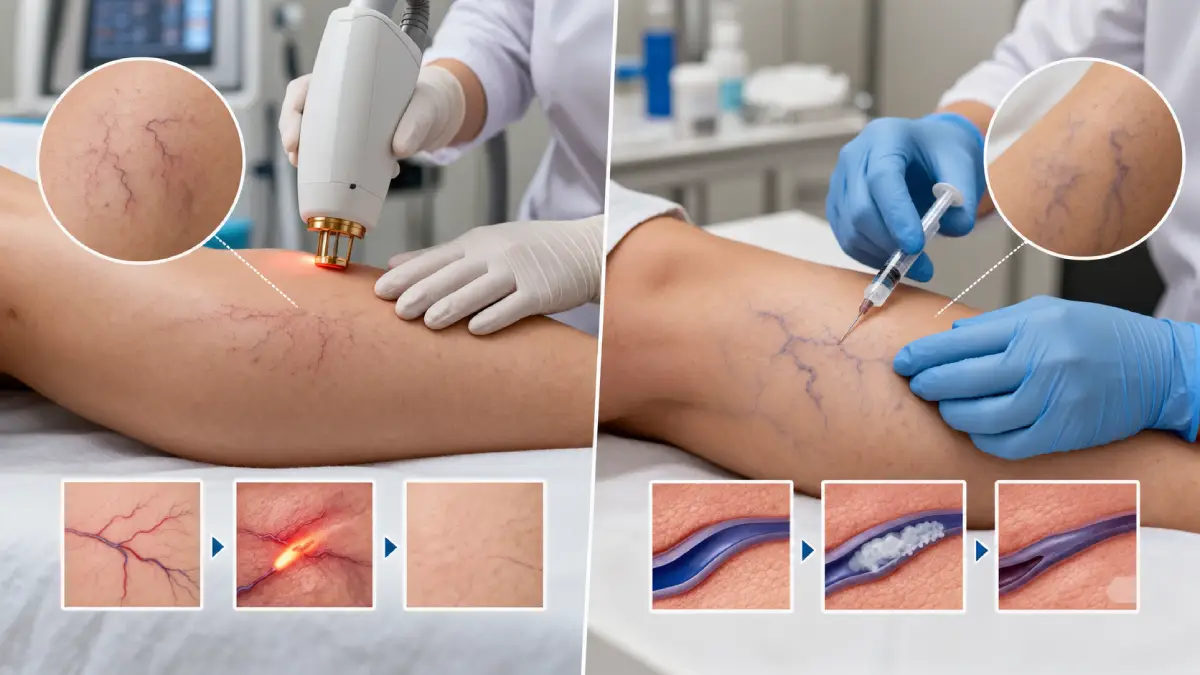
Laser therapy uses light that heats a vessel until its walls close. Injections deliver a solution that irritates the vein lining, causing it to seal from the inside. Light suits fine surface vessels, especially on the face, while injections reach larger vessels deeper in the leg, and a provider matches the method to each vessel during an in-person assessment.
Why Visible Veins Show Up in the First Place
Visible veins appear when small vessels near the skin surface widen and lose the ability to tighten back down. Once a vessel stays dilated, it stays visible.
Spider veins, known clinically as telangiectasias, are the fine red or purple lines sitting just under the surface, less than a millimeter across. Reticular veins are the flat bluish vessels roughly one to three millimeters wide, sitting slightly deeper. Genetics, sun exposure, pregnancy, hormonal shifts, long hours on your feet, and ordinary aging all push vessels in this direction.
Surface veins that only bother you visually are cosmetic. Veins that ache, bulge, or feel rope-like deserve evaluation by a vein specialist first, since those signs can point to circulation issues underneath.
How Vascular Laser Treatment Works
Laser vein treatment closes a vessel with heat. The device delivers a wavelength of light that hemoglobin, the red pigment inside blood, absorbs more readily than surrounding tissue. That energy heats the vessel wall until it collapses and seals, and your body clears it over the following weeks as the line fades.
Because the skin surface stays intact, light-based therapy became the practical option for facial vessels, where skin is thin.
At Soleil Medical & Beauty Spa, vascular treatment addresses facial veins, leg veins, angiomas (small red raised spots), venous lakes (soft bluish patches, often on the lip), and the diffuse redness associated with rosacea. Session count varies with how deep a lesion sits, assessed vessel by vessel.
How Sclerotherapy Works
Sclerotherapy closes a vessel from the inside. A provider injects a sclerosant solution through a very fine needle directly into the target vein. The solution irritates the inner lining; the walls swell and adhere, and the vessel seals shut, fading over the following weeks as the body reabsorbs it.
One common worry is worth answering plainly: closing a surface vein does not compromise circulation. Blood reroutes through healthier vessels nearby.
Injections have been the long-standing approach for leg veins because a needle reaches depths where light energy loses strength. A qualified provider performs this medical injection procedure, and candidacy is determined during an in-person consultation.
Vascular Laser Treatment vs. Sclerotherapy: Where Each One Fits
Size, depth, and location sort most cases. Neither method wins in the abstract, and providers who claim otherwise are usually describing the equipment they own.
- Fine surface vessels, especially anywhere on the face, generally favor light-based therapy.
- Larger reticular veins on the legs generally favor injection, since depth limits what light can reach.
- Facial vessels are rarely injected, which makes laser the practical choice above the neck.
- Skin tone affects device selection. Melanin also absorbs light energy, so Fitzpatrick skin type (a I to VI scale for how skin responds to light) guides the settings.
Needle tolerance is real, and it belongs in the conversation for anyone comparing spider vein treatment options. Vessels also behave unpredictably, so a textbook candidate for one method occasionally responds better to the other.
What Treatment Day and Recovery Look Like
Both treatments are office visits with limited downtime, though the experience differs. Most patients describe laser sessions as a brief snap against the skin, with cooling applied throughout. Temporary redness or mild swelling usually settles within a day or two.
Sclerotherapy involves a quick sting with each injection. Compression stockings are typically worn afterward for a period the provider specifies; walking is encouraged, and strenuous exercise and heat are paused for several days.
Neither clears a vein instantly. Both typically require more than one session, and results emerge gradually over weeks. Individual response varies.
How a Provider Makes the Call (And When Both Are Used)
A consultation settles what the reading cannot. Your provider maps visible vessels, assesses how deep each sits, checks skin type, and reviews your health history and any medications that affect bleeding or healing.
Combination sequencing is common when both vessel types appear on the same leg. We address deeper feeding vessels first, since leaving them untreated often means the surface branches refill.
At Soleil Medical & Beauty Spa, we offer Vascular Treatment and Skin Tag Removal in Portland, OR using light-based technology, and our team can walk you through what vascular treatment addresses and how sessions are planned. For broader facial redness and pigmentation, laser skin rejuvenation using IPL is sometimes the better starting point.
Matching the Treatment to the Vein
The honest answer is that the vein chooses. Light handles fine surface vessels and facial redness well. Injections reach the deeper leg vessels that light cannot close efficiently. Some people fit neatly into one category; others benefit from a sequenced combination.
Practically, that means skipping the search for a universal winner and having the vessels assessed. Fifteen minutes of assessment tells you more than weeks of comparison reading, because your provider can see how deep each vessel actually sits.
If visible veins have been on your mind, a consultation at Soleil Medical & Beauty Spa is a low-pressure place to start. We’ll review what you are dealing with, talk through vascular laser treatment vs. sclerotherapy for your vessels, and give you a realistic sense of what to expect.